
Showing posts with label Asian Studies. Show all posts

Aaron Sinift, Kahkashan Khan, Jitendra Kumar


December 8, 2021.

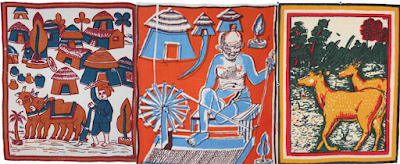
The Artist Aaron Sinift and project co-curators Kahkashan Khan and Jitendra Kumar discuss the artist book featured in the exhibition "OTHER IMAGININGS: Artist Collaborations with Gandhi Ashrams" on view in the Vassar College Art Library through March 4, 2022.

As western modes of advertising and television began to be adopted in India on a mass level in the early ’90s, there was a shift towards a generic global style in popular culture. The uniquely S. Asian styles of portrayal which flourished in the pre-digital era began to disappear as the imagination began to be more aggressively colonized. As vestiges of Gandhi ashram visual culture become rarer in public it is evident that we are nearing the end of a particular visual era that helped define a unique sense of Gandhian social purpose and national identity as popularly understood after Indian Independence.
 
The images in this book are traces of a world that exists even today and continues to provide a baseline means of self-sufficiency for tens of millions of people. Yet how we express ourselves is being transformed by our present circumstances and at this very moment is searching for its compelling voice. Perhaps this book is an opportunity to catch a glimpse before it’s gone of a more local sensibility that is unimpressed by glamour and worldliness, more focused on the ideals of communal harmony and love of country, particularly its rural pastoralist culture, what Gandhiji called “India’s heart and soul.”
 
As we reflect on these unique qualities (rasa), it is important as well to consider the present, the point from which we encounter the future, and from which we must find our voice. OTHER IMAGININGS is intended to create community (you included) and assert absolute equivalence among all participants so that no labor, no effort, no artist known or unknown is prized above any other. This artwork is an attempt to weave together stories rooted in community in order to create a primal resource for understanding and collaboration.

Listen

Bryan W. Van Norden

 
Kano Toshun Yoshinobo (1747-1797). The Three Laughers of Tiger Ravine, 1886 (Fenollosa-Weld Collection).

September 23, 2020.

Bryan W. Van Norden, Professor of Philosophy on the James Monroe Taylor Chair at Vassar, talks about his recent monograph, Taking Back Philosophy: A Multicultural Manifesto (Columbia UP, 2017).

Are American colleges and universities failing their students by refusing to teach the philosophical traditions of China, India, Africa, and other non-Western cultures? This biting and provocative critique of American higher education says yes. Even though we live in an increasingly multicultural world, most philosophy departments stubbornly insist that only Western philosophy is real philosophy and denigrate everything outside the European canon. In Taking Back Philosophy, Bryan W. Van Norden lambastes academic philosophy for its Eurocentrism, insularity, and complicity with nationalism and issues a ringing call to make our educational institutions live up to their cosmopolitan ideals.


Listen

Herman Eberhardt

Ayako Matsushita on her graduation day from Heart Mountain High School. Before the war she attended Marshall High School in Los Angeles.
Frank Hirahara 1944

October 25, 2017.

Herman Eberhardt, Supervisory Curator at the Franklin Delano Roosevelt Presidential Library and Museum, discusses the Library and Museum in Hyde Park, New York, and his exhibition: Images of Internment: The Incarceration of Japanese Americans During World War II, on view in the Library's William J. vanden Heuvel Gallery through December 31, 2017.

Karen Lucic

May 6, 2015 (SEASON FINALE).

Karen Lucic, Professor of Art at Vassar College, talks about her exhibition on view in the Frances Lehman Loeb Art Center May 3  - July 28, 2015, entitled "Embodying Compassion in Buddhist Art: Image, Pilgrimage, Practice." 

Embodying Compassion in Buddhist Art: Image, Pilgrimage and Practice is the first transcultural exhibition in America solely devoted to the bodhisattva Avalokiteshvara, who emerged in India two thousand years ago to become a venerated deity throughout Asia. Like all bodhisattvas, this figure selflessly leads others to enlightenment, but Avalokiteshvara’s special role is to exemplify limitless compassion, a fundamental ideal in Mahayana Buddhism. 

59:04 minutes.

Listen

Exhibition website

Nepal Earthquake Relief (Rubin Museum Site)

Peipei Qiu

February 11, 2015. 

Peipei Qiu, Professor of Chinese and Japanese on the Louise Boyd Dale and Alfred Lichtenstein Chair and Director of Asian Studies at Vassar, talks about her book Chinese Comfort Women: Testimonies from Imperial Japan's Sex Slaves, published this year by Oxford University Press.

"Chinese Comfort Women: Testimonies from Imperial Japan's Sex Slaves features the personal narratives of twelve women forced into sexual slavery when the Japanese military occupied their hometowns. Beginning with their prewar lives and continuing through their enslavement to their postwar struggles for justice, these interviews reveal that the prolonged suffering of the comfort station survivors was not contained to wartime atrocities but was rather a lifelong condition resulting from various social, political, and cultural factors. In addition, their stories bring to light several previously hidden aspects of the comfort women system: the ransoms the occupation army forced the victims' families to pay, the various types of improvised comfort stations set up by small military units throughout the battle zones and occupied regions, and the sheer scope of the military sexual slavery-much larger than previously assumed. The personal narratives of these survivors combined with the testimonies of witnesses, investigative reports, and local histories also reveal a correlation between the proliferation of the comfort stations and the progression of Japan's military offensive."


39:01 minutes.

Listen 

Karen Hwang & Patricia Phagan

October 30, 2013.

Karen Hwang, Assistant Professor of Art at Vassar College, and Patricia Phagan, Philip and Lynn Straus Curator of Prints and Drawings at the Frances Lehman Loeb Art Center at Vassar, will discuss the traveling exhibition currently on view at the Center through December 15, 2013  entitled "Genji's World in Japanese Woodblock Prints."

 "The Tale of Genji, written in the eleventh century by the Japanese court lady Murasaki Shikibu, has greatly influenced Japanese culture, from novels and kabuki performances to today’s manga and animé. That influence can be clearly seen in the works in this exhibition, which features a rich array of fifty-seven woodblock prints by many of Japan’s leading eighteenth- and nineteenth-century artists."

39:05 minutes

Listen

Andrew Watsky

February 20, 2007

Andrew Watsky, art historian and professor of art at Vassar College, discusses his award-winning book about the Japanese island of Chikubushima, it's history, architecture, and art.
49:59 min.

Listen