Listen
Beauty out of the Ashes
Listen
Yvonne Elet
Franc Palaia
May 11, 2022.
Rhinebeck artist Franc Palaia talks about his catalogue raisonné : Wall Works: Frescoes, Photo-Sculpture and Mixed Media 1973-2021. The discussion will help to introduce a restrospective exhibit that will be on view of Palaia's "Large scale frescoes and photo-sculptures installed to simulate a contemporary archeological site"at the Hudson Beach Glass Gallery on view May 14 - June 5, 2022 in Beacon, New York.
"I have been photographing walls, murals, signs, graffiti, street art, architecture and billboards since 1976. In my travels of 26 countries, I have compiled thousands of urban wall images that I use as reference for my wall works. I am a multi-disciplinary artist and work in photography, painting, sculpture and murals where I incorporate all four mediums into mixed media flat wall pieces and 3-dimensional floor sculptures. I have a saying: `walls are drop cloths of a society', whatever you seen on a city's walls gives you a sense of what is happening in that particular city or country. They signal the current state of their economy, politics and social condition." -- from Franc Palaia, "Artist Statement."
copies of the catalog are obtainable by emailing Franc Palaia at francpalaia1@gmail.com
Elizabeth Nogrady and Jill Schneiderman
In 1914, literary naturalist and Hudson Valley resident John Burroughs wrote, “In the snow-storm: we are admitted into Nature’s oldest laboratory.” This laboratory is part of the cryosphere, the term given to places on Earth where water is in solid, rather than liquid, form. Describing the fleeting and varied forms of the cryosphere—ice and snow in particular—is a challenge shared by artists and scientists alike. This Focus Gallery exhibition applies the approach and knowledge of an earth scientist to art that focuses on the cryosphere, with the aim of enhancing viewers’ understanding of not only the works themselves, but also the planet we inhabit. It features paintings, prints, photographs and sculpture from the nineteenth century to the present day, including works by Sanford Robinson Gifford, Taguchi Beisaku, Doris Lee, and Oshutsiak Pudlat. This exhibition is co-organized by the Loeb and Jill Schniederman, professor of Earth Science.
Aaron Sinift, Kahkashan Khan, Jitendra Kumar
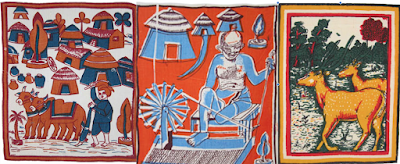
The images in this book are traces of a world that exists even today and continues to provide a baseline means of self-sufficiency for tens of millions of people. Yet how we express ourselves is being transformed by our present circumstances and at this very moment is searching for its compelling voice. Perhaps this book is an opportunity to catch a glimpse before it’s gone of a more local sensibility that is unimpressed by glamour and worldliness, more focused on the ideals of communal harmony and love of country, particularly its rural pastoralist culture, what Gandhiji called “India’s heart and soul.”
As we reflect on these unique qualities (rasa), it is important as well to consider the present, the point from which we encounter the future, and from which we must find our voice. OTHER IMAGININGS is intended to create community (you included) and assert absolute equivalence among all participants so that no labor, no effort, no artist known or unknown is prized above any other. This artwork is an attempt to weave together stories rooted in community in order to create a primal resource for understanding and collaboration.
Changing Forms
Celebrating Dante at Vassar
Suzanne Preston Blier
“It is a condition of masterworks that they attract, even demand, interpretation and reinterpretation. Picasso's Les Demoiselles d’Avignon is a case in point. In 1946, Alfred Barr called it ‘a battlefield of trial and experiment’ marking ‘the beginning of a new period in the history of modern art.’ Twenty-six years later, Leo Steinberg argued that its psychic and pictorial ‘violence’ resides in its power of displacement, in ‘the startled consciousness of a viewer who sees himself seen.’ Others have examined its ‘primitivism’ and l’art negre as central to its power and originality. Now, Suzanne Blier, through a close textual and visual analysis of an astonishing range of references, argues that Picasso’s creativity ‘involved both drawing on and subverting the past’ while reimagining the present and creating the future anew. Blier's study rewards close reading, just as the painting rewards close and sustained looking.” — James Cuno, President and CEO, The J. Paul Getty Trust
“Combining the specialized skills of an art historian with the zeal of a detective, Suzanne Preston Blier offers a bold and transformative re-reading of the Demoiselles. She startlingly shifts the interpretive foundations of Picasso and the Demoiselles: she shows us a Picasso not as bombastic egotist but as capacious globalist; not as masculine master fixated on female sexuality and its attendant anxieties, but as explorer of the power and presence of women and their generative capacities. This provocative and pathbreaking book scrambles the logic of modernism, primitivism, and feminism in the discipline of art history.” — Debora Silverman, author of Van Gogh and Gauguin: The Search for Sacred Art
Patricia Phagan
Buzz Spector
"Taking cues from Marcel Duchamp and Marcel Broodthaers—two influential 20th-century artists whose careers shaped the course of contemporary art—Spector draws from art historical precedents and adapts borrowed materials, injecting poetic humor and philosophical musings along the way. . . .
"Spector is internationally recognized for his contributions to the field of contemporary art. He taught painting, sculpture, and two-dimensional design at the Sam Fox School of Design & Visual Arts at Washington University in St. Louis for a decade before retiring in 2019. This is the first presentation of the artist’s work at a St. Louis museum."
The Rowland Atkinson skit we mention.
Art Speaks: a 53 minute video on Buzz Spector: Alterations by SLAM
Miriam Cohen and Mark G. Seidl
Laurie Lisle
"Portrait of an Artist is a sensitive and beautifully documented biography. It moved me deeply--I can't remember when a book involved me so totally."
Patricia Bosworth, author, Diane Arbus: A Biography
"What a personality emerges from these pages!...Portrait of an Artist is filled with riches."
Joyce Carol Oates, Mademoiselle
"Through interviews with O'Keeffe's friends and acquaintances, by delving into the published an unpublished sources and letters...she gives a fine and poignant accounting of the relationship between O'Keeffe and Stieglitz...Above and beyond the personal portrait, Lisle's biography is a marvelous evocation of the American places that have been important in the development of O'Keeffe's character and her art."
James R. Mellow, The Saturday Review
David Tavárez
Liza Donnelly
| Photograph by Elena Rossini |
Cartoonist, activist, author, and frequent visiting Vassar professor Liza Donnelly visits to talk about cartooning and the retrospective exhibition of her work, Liza Donnelly: Comic Relief, on view at the Norman Rockwell Museum in Stockbridge, Massachusetts. Liza is a New Yorker staff cartoonist, a resident cartoonist for CBS News, and has published in a host of news and cultural outlets, including the New York Times, The Nation, CNN, Cosmopolitan, Cobblestone, Habitat, the Daily Beast, Open Salon, Forbes, and the Huffington Post. She is also a columnist on politics and global women's rights for the online journal Medium Magazine. Among her 17 published books are Funny Ladies: The New Yorker's Greatest Women Cartoonists and Their Cartoons, and a series of illustrated children's books.
Other links to Donnelly's work:
Laurie Lisle
![]() |
| Louise Nevelson with her cats, 1975, Pedro E. Guerrero, Vintage Silver Bromide Print |
Author and biographer Laurie Lisle discusses her book Louise Nevelson: A Passionate Life (Simon & Schuster 1990; Rev. Ed., Open Road, 2016.)
'From her birth in Russia, her girlhood in Maine, to her years as an artist in Manhattan, Nevelson's life was difficult, dramatic and, after years of struggle, finally triumphant. Her rich iconography expressed in black, white, and gold wooden assemblages is an enormous and extraordinary prize-winning body of work found in parks, plazas, and museums throughout the world. Lisle has conscientiously investigated the numerous bizarre events in Nevelson's long life" -Washington Post Book World
"Lisle's book is impressive in its thoroughness . . . its eclectic introduction of psychological analysis" -Woman's Art Journal
Patricia Phagan
Frances Lehman Loeb Art Center curator Patricia Phagan talks about the exhibition Louise Bourgeois: Ode to Forgetting, From the Collections of Jordan D. Schnitzer and His Family Foundation, on view January 24 - April 5, 2020.
Louise Bourgeois (1911–2010) is one of the most renowned artists of the twentieth and twenty- first centuries. She is perhaps best known for powerful sculptures, including monumental spiders, human figures, and anthropomorphic shapes. An enigmatic chronicler of her emotions, she confided in her diaries, made drawings daily, and returned regularly to printmaking. The exhibition focuses on prints she made in her eighties and nineties, with a few earlier examples and a massive spiral sculpture to give additional context. She made art because she had to, and described her practice as a means of survival, a lifelong managing of emotional vulnerabilities, traumas, and nightmares. As she put it, “Art is a guarantee of sanity.”
Wendy N. E. Ikemoto
![]() |
| John Frederick Kensett (1816–1872), View from Cozzens’ Hotel, near West Point, N.Y., 1863 [detail] Oil on canvas |
Wendy Ikemoto, Associate Curator of American Art at the New-York Historical Society Museum & Library, discusses her exhibition: Panoramas: The Big Picture, on view at the Society through December 8, 2019.
Panoramas: The Big Picture explores the history and continued impact of panoramas from the 17th to the 21st century, as they were used to create spatial illusions, map places, and tell stories. Highlights include John Trumbull’s sweeping double vistas of Niagara Falls (1808), sections of Richard Haas’ nearly 200-foot long trompe l’oeil panorama of Manhattan (1982), and Eadweard Muybridge’s 17-foot photographic panorama of San Francisco before the city’s devastating 1906 earthquake (1878). The exhibition examines and reveals the impact that these and other panoramas had on everything from mass entertainment to nationalism to imperial expansion.
Mary-Kay Lombino
![]() |
| Richard Barnes, Murmur #23, Dec. 6, 2006, 2006 |
Mary-Kay Lombino, Curator of Collections at the Frances Lehman Loeb Art Center at Vassar, discusses her exhibition Shape of Light: Defining Photographs from the Frances Lehman Loeb Art Center, on view through December 15, 2019.
Shape of Light: Defining Photographs from the Frances Lehman Loeb Art Center presents a survey of Vassar’s renowned collection of close to 4,500 photographs. Spanning the history of the medium, the exhibition features numerous innovations in the history of photography including various types of photographic practices from daguerreotypes and gelatin silver prints to large-scale Polaroids and digital color prints as well as a wide range of styles and geographic focuses. This extensive exhibition, the first of its kind at the Art Center, aims to highlight the Art Center’s long interest and dedication to the photographic medium and present the unique character, depth, and diversity of the collection. Shape of Light also celebrates twenty years of commitment from the Advisory Council for Photography for supporting photography acquisitions.
Listen
H. Daniel Peck
![]() |
| Thomas Cole. Detail from View on the Catskill--Early Autumn, 1836–37. Metropolitan Museum of Art, NY |
Thomas Cole's Refrain shows how Cole's Catskill Creek paintings, while reflecting concepts such as the stages of life, opened a more capacious vision of experience than his narrative-driven series, such as The Voyage of Life. Relying on rich visual evidence provided by paintings, topographic maps, and contemporary photographs, Peck argues that human experience is conveyed through Cole's embedding into a stable, recurring landscape key motifs that tell stories of their own. The motifs include enigmatic human figures, mysterious architectural forms, and particular trees and plants. Peck finds significant continuities—personal and conceptual—running throughout the Catskill Creek paintings, continuities that cast new light on familiar works and bring significance to ones never before seen by many viewers.
James Mundy
![]() |
| Edvard Munch, “Moonlight” (1896). Frances Lehman Loeb Art Center, Gift of Philip and Lynn Strauss, Class or 1946, 1995.20 |