Showing posts with label Internationalism. Show all posts

Bryan W. Van Norden

 
Kano Toshun Yoshinobo (1747-1797). The Three Laughers of Tiger Ravine, 1886 (Fenollosa-Weld Collection).

September 23, 2020.

Bryan W. Van Norden, Professor of Philosophy on the James Monroe Taylor Chair at Vassar, talks about his recent monograph, Taking Back Philosophy: A Multicultural Manifesto (Columbia UP, 2017).

Are American colleges and universities failing their students by refusing to teach the philosophical traditions of China, India, Africa, and other non-Western cultures? This biting and provocative critique of American higher education says yes. Even though we live in an increasingly multicultural world, most philosophy departments stubbornly insist that only Western philosophy is real philosophy and denigrate everything outside the European canon. In Taking Back Philosophy, Bryan W. Van Norden lambastes academic philosophy for its Eurocentrism, insularity, and complicity with nationalism and issues a ringing call to make our educational institutions live up to their cosmopolitan ideals.


Listen

Nicholas Adams

Beinecke Rare Books Library, Yale University
February 5, 2020.

Nicholas Adams discusses his biography of the 20th century architect whose work defined the built environment of corporate modernism: Gordon Bunshaft and SOM: Building Corporate Modernism (Yale University Press 2019).

Gordon Bunshaft’s (1909–1990) landmark 1952 design for Lever House reshaped the Manhattan skyline and elevated the reputation of Skidmore, Owings & Merrill (SOM), the firm where he would spend more than 40 years as a partner. Although this enigmatic architect left behind few records, his legacy endures in the corporate headquarters, museums, and libraries that were built in his distinctive modernist style. Bunshaft’s career was marked by shifts in material. Glass and steel structures of the 1950s, such as New York’s Chase Manhattan Bank, gave way to revolutionary designs in concrete, such as the Beinecke Rare Book and Manuscript Library at Yale University and the doughnut-shaped Hirshhorn Museum in Washington, DC. Bunshaft’s collaborations with artists, including Isamu Noguchi, Jean Dubuffet, and Henry Moore, were of paramount importance throughout his career.

Nicholas Adams explores the contested line between Bunshaft’s ambition for acclaim as a singular artistic genius and the collaborative structure of SOM’s architectural partnership. Bunshaft received the Pritzker Architecture Prize in 1988 and remains the only SOM partner to have achieved this distinction. Adams counters Bunshaft’s maxim that “the building speaks for itself” with necessary critical context about this modernist moment at a time when the future of Bunshaft’s iconic works is very much in question.


Ronald Patkus, Nikolai Firtich, Dan Ungurianu

April 10, 2019.

Historian and Associate Director of the Library for Special Collections Ronald D. Patkus joins Professors Nikolai Firtich and Dan Ungurianu of the Vassar Department of Russian to discuss the great Russian writer Ivan Turgenev (1818-1883) and the exhibit on view 23 January through June 10, 2019 in the Thompson Memorial Library entitled Ivan Turgenev and His Library, celebrating the bicentennial of Turgenev's birth.

Download the exhibition catalogue (PDF)


Charles Henry


March 13 & April 3 (repeat), 2019.

What is a library? Charles Henry, President of the Council on Libraries and Information Resources (CLIR) and former Director of Libraries at Vassar College, walks us through the door of that question as he is interviewed on February 27, 2019 for Radio New Zealand's popular program Nine to Noon  by that program's host Kathryn Ryan. He goes on to discuss CLIR's role in organizing the creation of a truly global digital library, and the promise of this effort for preserving cultural memory from threats of war and climate change. He also speculates on the potential of digital technology to enable literal discovery through the uncovering of hidden information.

34:19 minutes.

Bailey Van Hook

Violet Oakley.  The Great Wonder: Vision of the Apocalypse, Vassar College, Alumnae House, 1924.  Oil on panel.

February 20, 2019.

Bailey Van Hook, Professor of Art History and co-director of the MA Program in Material Culture and Public Humanities at Virginia Polytechnic Institute and State University, discusses her biography Violet Oakley: An Artist's Life (University of Delaware Press, 2016).  

"Violet Oakley: An Artist's Life is the first full-length biography of Violet Oakley (1874–1961), the only major female artist of the beaux-arts mural movement in the United States, as well as an illustrator, stained glass artist, portraitist and author. There is much human interest here: a pampered and spoiled young woman who suddenly finds herself in near poverty, forced to make a living in illustration to support her parents; a sensitive and idealistic young woman who, in a desperate attempt to save her neurasthenic father, embraces Christian Science, a religion derided by her family and friends; a 28 year old woman who receives one of the plum commissions of the era, a mural cycle in the Pennsylvania State Capitol, in a field dominated by much older and predominantly male artists; a woman in her forties who although professionally successful finds herself very much alone and bonds with her student, Edith Emerson; a friend of artists like dancer Ruth St. Denis and violinist Albert Spalding who nevertheless was supremely conscious of social mores, the “Miss Oakley” of the Social Register who preferred the company of upper class to bohemian society; the tireless self-promoter who traveled abroad to become the unofficial visual historian of the League of Nations yet who ironically was increasingly regarded as a local artist."


Roberta Shaffer

May 14, 2014. 

Roberta Shaffer (VC'74), Associate Librarian for Library Services at the Library of Congress and former Dean of the Library School at the University of Texas, Austin, talks in an interview recorded in her offices about the Library of Congress, its organization, structure, architecture, collections, spirit, and historic mission, as well as about library education and librarianship as a career in our information-driven society. 

43:42 minutes.


Alex Byrne

April 8, 2008.

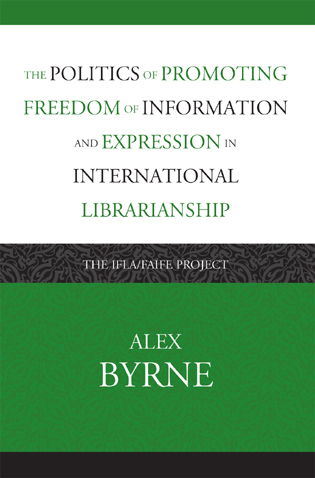
Alex Byrne, University Librarian at the University of Technology, Sydney, and 2005-2007 President of the International Federation of Library Associations and Institutions (IFLA), discusses intellectual freedom advocacy, libraries, internationalism, and his book: The Politics of Promoting Freedom of Information and Expression in International Librarianship, published by Scarecrow.

49:48 min.

Listen