Showing posts with label Humanism. Show all posts

Haohao Lu


February 8, 2023. 

Haohao Lu, Assistant Professor of Art at Vassar College, talks about her article in the December issue of Ludica: Annali di storia e civiltà del gioco, entitled: “Games, Flirtation, and the Use of Interpretive Risk: Jan Sanders van Hemessen’s Portrait of Husband and Wife Playing Tables.
Listen

Michael Witmore


December 14, 2016.

Michael Witmore
 (VC '89), Shakespeare scholar and Director of the Folger Shakespeare Library, talks about the Folger's mission, history, and public programs, and about Shakespeare as an educational force in American life on the 400th anniversary of Shakespeare's death. 

38:53 minutes

Listen

Adam Michaels and Jeffrey T. Schnapp


October 26, 2016.

In a new installment of our series on the role of liberal arts education in contemporary society, c0-authors Adam Michaels, principle designer at Project Projects and founder of Inventory Press, and Jeffrey T. Schnapp (VC'75), Co-director of the Berkman Center for the Internet and Society and Faculty Director of the Harvard Graduate School of Design's knowledge design studio metaLAB, talk about their reissue of Blueprint for Counter Education (Inventory, 2016).

"Perhaps one of the most extraordinary books ever issued by an American commercial publisher.” —Richard Kostelanetz

"Blueprint for Counter Education is one of the defining (but neglected) works of radical pedagogy of the Vietnam War era. Originally published in 1970 and integrated into the design of the Critical Studies curriculum at CalArts, the book was accompanied by large graphic posters that could serve as a portable learning environment for a new process-based model of education, and a bibliography and checklist that map patterns and relationships between radical thought and artistic practices—from the avant-gardes to postmodernism—with Marcuse and McLuhan serving as points of anchorage."

Blueprint Archive

43:22 minutes.

Listen

Amitava Kumar

December 16, 2015 


Amitava Kumar, Helen D. Lockwood Professor of English at Vassar College, discusses his new book of essays Lunch With a Bigot: The Writer in the World published this year by Duke University Press.

"These are the very best sort of essays: the kind in which the pleasure of reading derives from the pleasure of following a writer's mind as it moves from subject to subject, making us see connections we might otherwise have been unawayre of.  Often a single paragraph contains such a story or detail so arresting that the reader must pause to appreciate it before moving on." -- Francine Prose, author of Reading Like a Writer

55:29 minutes.

Stephen F. Eisenman

September 23, 2015.

Stephen F. Eisenman, Professor of Art History at Northwestern University, discusses our relationship with other species and his book, Cry of Nature: Art and the Making of Animal Rights (Reaktion, 2013).

"Stephen F. Eisenman shows how artists from William Hogarth to Pablo Picasso and Sue Coe have represented the suffering, chastisement, and execution of animals. These artists, he demonstrates, illustrate the lessons of Montaigne, Rousseau, Darwin, Freud, and others—that humans and animals share an evolutionary heritage of sentience, intelligence, and empathy, and thus animals deserve equal access to the domain of moral right."

52 :00 minutes.

Listen

Jerome McGann

April 8, 2015.

Jerome McGann, University Professor and John Stewart Bryan Professor of English at the University of Virginia, discusses his new book, A New Republic of Letters: Memory and Scholarship in the Age of Digital Reproduction (Harvard, 2014).

"A manifesto for the humanities in the digital age, A New Republic of Letters argues that the history of texts, together with the methods by which they are preserved and made available for interpretation, are the overriding subjects of humanist study in the twenty-first century. Theory and philosophy, which have grounded the humanities for decades, no longer suffice as an intellectual framework. Jerome McGann proposes we look instead to philology—a discipline which has been out of fashion for many decades but which models the concerns of digital humanities with surprising fidelity."

43:44 minutes.

Listen

Patricia Phagan

November 5, 2014.

Patricia Phagan, Philip and Lynn Straus Curator of Prints and Drawings at the Frances Lehman Loeb Art Center at Vassar, will discuss the exhibition currently on view at the Center through December 14, 2014 entitled: Imperial Augsburg: Renaissance Prints and Drawings, 1475-1540.

"Like Albrecht Dürer’s Nuremberg, the city of Augsburg was vital to the flowering of the Renaissance in Germany. The exhibition features prints, drawings, illustrated books, medals, and armor from Augsburg and addresses the themes of Christian devotion and the Reformation, moral conduct and everyday life, and art made for Holy Roman Emperor Maximilian I."

34:41 minutes.

Johanna Drucker

October 29, 2014.

Scholar, artist, printer, and visual theorist Johanna Drucker, Breslauer Professor of Bibliographical Studies at the Graduate School of Education and Information Studies at the University of California, Los Angeles, discusses her book Graphesis: Visual Forms of Knowledge Production (Harvard 2014).

"Information graphics bear tell-tale signs of the disciplines in which they originated: statistics, business, and the empirical sciences. Drucker makes the case for studying visuality from a humanistic perspective, exploring how graphic languages can serve fields where qualitative judgments take priority over quantitative statements of fact. Graphesis offers a new epistemology of the ways we process information, embracing the full potential of visual forms and formats of knowledge production."


48:20  minutes

Listen 

Elizabeth Eisenstein

May 28, 2014. (SEASON FINALE):

Elizabeth Eisenstein (VC'45), author of the massively influential history on the impact of the introduction of printing on Western society, The Printing Press as an Agent of Change (2 vols., Cambridge 1979), will discuss her book Divine Art, Infernal Machine: The Reception of Printing in the West (U Penn, 2011).

"Eisenstein's research is impressive, reaching far and wide across languages and centuries. Her knowledge of the history of publication engages the wealth of recent scholarship and extends as far back as Roman copyists. . . . Her breadth enables her to identify topoi and their mutations; to observe long-term trends, diminishing ripples, and delayed reactions; and to distinguish what is new or newly dressed in authors' concerns and readers' complaints."— Journal of Scholarly Publishing

45:57 minutes.

Listen

Christopher D. Johnson

April 9, 2014.

Christopher D. Johnson, Professor of early modern literature in the Department of Spanish and Portuguese at UCLA, discusses his book, Memory, Metaphor, and Aby Warburg's Atlas of Images, published by Cornell University Press in 2012.

"This is a rich and learned book, and also an extremely humane and attractive one. The final chapter, on Warburg and Bruno, has the status of revelation. It is absolutely fascinating, not only as a dialogue in intellectual history but also as a political allegory. Christopher D. Johnson pays close attention to Warburg's ethical and epistemological aspirations when he focuses on Warburg’s final and uncompleted project: the Atlas of Images. Assembled during the years prior to his death in 1929, these collages strove to mount a history of cultural memory via a dense series of images from antiquity to the present." — Michael P. Steinberg, Brown University

45:24 minutes.

Listen 

View select panels from Warburg's Bilderatlas and other materials on the book's companion website.

Robert DeMaria, Jr.

March 5, 2014.

Robert DeMaria, Jr., Henry Noble McCracken Professor of English at Vassar College, talks about the paragon of eighteenth-century English scholarship and letters Samuel Johnson, Johnson's reading habits, his monumental Dictionary of the English Language, scholarly editing, and the final installments of the Yale Edition of the Works of Samuel Johnson.

33:42 minutes.

Listen

Ann M. Blair

November 20, 2013.

Harvard College Professor and Henry Charles Lea Professor of History Ann Blair will discuss her book Too Much to Know: Managing Scholarly Information Before the Modern Age, published by Yale University Press in 2011.

"There has always been 'too much to know.' In this lively and learned book, Ann Blair shows us how early modern Europeans managed to survive—and even to surf—what they saw as tidal waves of information. Her insightful comparisons, careful attention to the survival of traditional methods, and clear vision of the new culture of passionate curiosity that took place in the Renaissance give her work extraordinary range and depth." — Anthony Grafton.

53:14 minutes.

Listen

Joseph A. Dane

April 10, 2013.

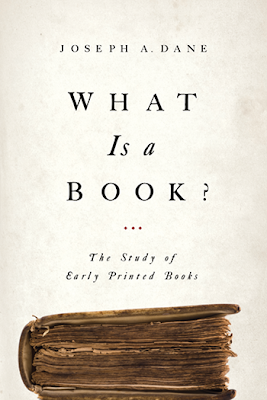
Joseph A. Dane discusses his book, What Is a Book?: The Study of Early Printed Books, Published by the University of Notre Dame Press in 2012.

“Joseph A. Dane is one of our most brilliant and prolific scholars of the early book, and this volume culminates a lifetime of research. For the general reader, it will offer a compelling survey of book history and book making. For the specialist, it will offer insights into the techniques of printers and the lives of collectors. For anyone concerned with how we read the past, and for anyone fascinated by the book as typographical artifact, What Is a Book? will be deeply valued." -- Seth Lehrer, UCSD.


49:56 minutes. 

Listen

Michael H. McCarthy

February 27, 2013.

Michael H. McCarthy, Professor Emeritus of Philosophy at Vassar College, discusses one of the Twentieth Century's most important political philosophers, Hannah Arendt, and his book: The Political Humanism of Hannah Arendt, published in 2012 by Lexington Books.

In this penetrating analysis, McCarthy reveals how anti-political biases within the Western philosophical tradition spawned 'anthropologies' that Arendt regarded as profoundly at odds with human dignity, plurality, and freedom. Rejecting both the reductionism that conflates people with beasts and the romanticism that conflates them with gods, Arendt emerges as a civic republican whose highest political virtue is devotion to a common world that, by uniting and separating us, allows us to actualize the full range of human possibilities."   -- Sandra K. Hinchman.

79:49 minutes 

Listen

Lisa Kaborycha

November 14, 2012.

Lisa Kaborycha, Director of Academic Affairs at the Medici Archive Project and Professor of History at the University of California EAP in Florence, talks about the project and its extraordinary educational and research programs. This December the Medici Archive Project will launch its BIA digital interactive platform on the Web, which will eventually provide digital access to between three and four million letters and other documents in the archives of the Medici Granducal Collection, and promises to revolutionize research in early modern studies across the disciplines.

42:02 min. 

Listen

Nancy Bisaha

March 4, 2008.

Nancy Bisaha, professor of history at Vassar College, talks about her book, Creating East and West: Renaissance Humanists and the Ottoman Turks, which "underscores the importance of this period for the evolution of concepts such as East and West, Europe and Asia, and suggests how these Renaissance views ... may still inform the modern discourse on Islam and the West." - RQ

50:10 min.

Listen