
December 8, 2021.
The Artist Aaron Sinift and project co-curators Kahkashan Khan and Jitendra Kumar discuss the artist book featured in the exhibition "OTHER IMAGININGS: Artist Collaborations with Gandhi Ashrams" on view in the Vassar College Art Library through March 4, 2022.
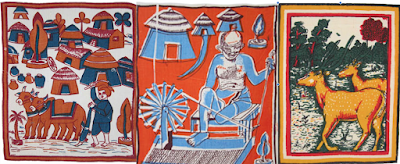
As western modes of advertising and television began to be adopted in India on a mass level in the early ’90s, there was a shift towards a generic global style in popular culture. The uniquely S. Asian styles of portrayal which flourished in the pre-digital era began to disappear as the imagination began to be more aggressively colonized. As vestiges of Gandhi ashram visual culture become rarer in public it is evident that we are nearing the end of a particular visual era that helped define a unique sense of Gandhian social purpose and national identity as popularly understood after Indian Independence.
The images in this book are traces of a world that exists even today and continues to provide a baseline means of self-sufficiency for tens of millions of people. Yet how we express ourselves is being transformed by our present circumstances and at this very moment is searching for its compelling voice. Perhaps this book is an opportunity to catch a glimpse before it’s gone of a more local sensibility that is unimpressed by glamour and worldliness, more focused on the ideals of communal harmony and love of country, particularly its rural pastoralist culture, what Gandhiji called “India’s heart and soul.”
As we reflect on these unique qualities (rasa), it is important as well to consider the present, the point from which we encounter the future, and from which we must find our voice. OTHER IMAGININGS is intended to create community (you included) and assert absolute equivalence among all participants so that no labor, no effort, no artist known or unknown is prized above any other. This artwork is an attempt to weave together stories rooted in community in order to create a primal resource for understanding and collaboration.
The images in this book are traces of a world that exists even today and continues to provide a baseline means of self-sufficiency for tens of millions of people. Yet how we express ourselves is being transformed by our present circumstances and at this very moment is searching for its compelling voice. Perhaps this book is an opportunity to catch a glimpse before it’s gone of a more local sensibility that is unimpressed by glamour and worldliness, more focused on the ideals of communal harmony and love of country, particularly its rural pastoralist culture, what Gandhiji called “India’s heart and soul.”
As we reflect on these unique qualities (rasa), it is important as well to consider the present, the point from which we encounter the future, and from which we must find our voice. OTHER IMAGININGS is intended to create community (you included) and assert absolute equivalence among all participants so that no labor, no effort, no artist known or unknown is prized above any other. This artwork is an attempt to weave together stories rooted in community in order to create a primal resource for understanding and collaboration.


