Showing posts with label Cultural Democracy. Show all posts

Aaron Sinift, Kahkashan Khan, Jitendra Kumar


December 8, 2021.

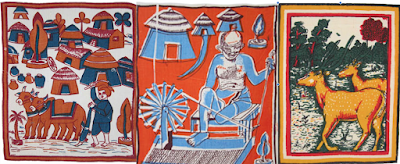
The Artist Aaron Sinift and project co-curators Kahkashan Khan and Jitendra Kumar discuss the artist book featured in the exhibition "OTHER IMAGININGS: Artist Collaborations with Gandhi Ashrams" on view in the Vassar College Art Library through March 4, 2022.

As western modes of advertising and television began to be adopted in India on a mass level in the early ’90s, there was a shift towards a generic global style in popular culture. The uniquely S. Asian styles of portrayal which flourished in the pre-digital era began to disappear as the imagination began to be more aggressively colonized. As vestiges of Gandhi ashram visual culture become rarer in public it is evident that we are nearing the end of a particular visual era that helped define a unique sense of Gandhian social purpose and national identity as popularly understood after Indian Independence.
 
The images in this book are traces of a world that exists even today and continues to provide a baseline means of self-sufficiency for tens of millions of people. Yet how we express ourselves is being transformed by our present circumstances and at this very moment is searching for its compelling voice. Perhaps this book is an opportunity to catch a glimpse before it’s gone of a more local sensibility that is unimpressed by glamour and worldliness, more focused on the ideals of communal harmony and love of country, particularly its rural pastoralist culture, what Gandhiji called “India’s heart and soul.”
 
As we reflect on these unique qualities (rasa), it is important as well to consider the present, the point from which we encounter the future, and from which we must find our voice. OTHER IMAGININGS is intended to create community (you included) and assert absolute equivalence among all participants so that no labor, no effort, no artist known or unknown is prized above any other. This artwork is an attempt to weave together stories rooted in community in order to create a primal resource for understanding and collaboration.

Listen

Miriam Cohen and Mark G. Seidl

November 4, 2020.

Miriam Cohen, Professor of History on the Evalyn Clark Chair at Vassar College, and Vassar Special Collections Librarian and Cataloger Mark G. Seidl will discuss the exhibition entitled Votes for Women: Vassar and the Politics of Women's Suffrage, sponsored by the Vassar College Libraries to celebrate the centenary of the adoption of the Nineteenth Amendment in the United States.

Video of Robyn Muncy Lecture, Nov. 12 at 5:30 p.m.

Listen

Nicholas Adams

May 10, 2017: SEASON FINALE.

Architectural historian Nicholas Adams, Mary Conover Mellon Professor of Art at Vassar College, talks about the exhibition he conceived and helped to curate at the Buffalo & Erie County Public Library entitled Building Buffalo: Buildings from Books, Books from Buildings: Books on Architecture and Landscape from the Rare Book Collection of the Buffalo & Erie County Public Library, on view until March 31,  2018.


42:46 minutes


Robert O. McClintock

Morningside Park Stairway with Seligman Fountain, New York City
May 3, 2017.  

We continue our series on the value of the liberal arts in contemporary society with a conversation with Robert O. McClintock, John L. and Sue Ann Weinberg Professor Emeritus in the Historical and Philosophical Foundations of Education at Teacher's College, Columbia University in the City of New York, about his monograph, Formative Justice: To Make of Oneself What One Can and Should Become.


Text of Formative Justice (pdf).

44:28 minutes.

Listen

Gretchen Goldman

November 23 & December 7, 2016.

Gretchen Goldman, Research Director for the Center for Science and Democracy at the Union of Concerned Scientists, talks about the role of science in public policy, including issues ranging from scientific integrity in government decision-making to political interference in science-based standards on hydraulic facturing, climate change, sugar, and chemicals. Dr. Goldman holds a Ph.D. and M.S. in environmental engineering from the Georgia Institute of Technology, and a B.S. in atmospheric science from Cornell University. She has authored pieces for Science, The New York Times, NPR, The Boston Globe, Reuters, Politico, and Bloomberg.

44:57 minutes.

Listen


Union of Concerned Scientists website: http://www.ucsusa.org/

UCS Science Network (for scientists): http://www.ucsusa.org/science-network 

UCS on Facebook:  https://www.facebook.com/unionofconcernedscientists

Patricia Phagan

Anton Refregier. 1837, Printing the California Star. Color sketch for the Rincon Annex Murals on the History of San Francisco. Gift of Philip and Lynn Strauss,  FLLAC 2015.23.1.1

November 2, 2016.

Patricia Phagan, Philip and Lynn Strauss Curator of Prints and Drawings at the Frances Lehman Loeb Art Center at Vassar College, talks about her exhibition: Celebrating Heroes: American Mural Studies of the 1930s and 1940s from the Susan and Steven Hirsch Collection on view September 2 - December 18, 2016.

38:43 minutes.

Listen


Lisa Gitelman


September 17, 2014. (SEASON OPENER):

Lisa Gitelman, Professor of English and of Media, Culture, and Communication at New York University, will discuss her book Paper Knowledge: Toward a Media History of Documents (Duke University Press, 2014).

"Paper Knowledge is a remarkable book about the mundane: the library card, the promissory note, the movie ticket, the PDF (Portable Document Format). It is a media history of the document. Drawing examples from the 1870s, the 1930s, the 1960s, and today, Lisa Gitelman thinks across the media that the document form has come to inhabit over the last 150 years, including letterpress printing, typing and carbon paper, mimeograph, microfilm, offset printing, photocopying, and scanning. Whether examining late nineteenth century commercial, or "job" printing, or the Xerox machine and the role of reproduction in our understanding of the document, Gitelman reveals a keen eye for vernacular uses of technology. She tells nuanced, anecdote-filled stories of the waning of old technologies and the emergence of new. Along the way, she discusses documentary matters such as the relation between twentieth-century technological innovation and the management of paper, and the interdependence of computer programming and documentation. Paper Knowledge is destined to set a new agenda for media studies."

42:10 minutes.

Listen 

Roberta Shaffer

May 14, 2014. 

Roberta Shaffer (VC'74), Associate Librarian for Library Services at the Library of Congress and former Dean of the Library School at the University of Texas, Austin, talks in an interview recorded in her offices about the Library of Congress, its organization, structure, architecture, collections, spirit, and historic mission, as well as about library education and librarianship as a career in our information-driven society. 

43:42 minutes.


Dan Cohen


May 7, 2014.

Dan Cohen, Executive Director of the Digital Public Library of America, discusses the DPLA, its organization, programs, and aspirations on the occasion of its first anniversary. 


"[T]he DPLA will go beyond its basic mission of making the cultural heritage of America available to all Americans. It will provide opportunities for them to interact with the material and to develop materials of their own. It will empower librarians and reinforce public libraries everywhere . . . ."  -- Robert Darnton, NYRB May 22, 2014

39:39 minutes.

Listen

Robert Darnton

April 30, 2014.

Robert Darnton, Carl H. Pforzheimer University Professor and University Librarian at Harvard University talks about his book Poetry and the Police: Communication Networks in Eighteenth-Century Paris (Harvard, 2012).

"In 1749 Parisians feasted on a half-dozen poems that ridiculed Louis XV for being humiliated in foreign affairs by the Treaty of Aix-la-Chapelle as well as in the royal bed by an ignoble mistress. The king ordered a crackdown on unauthorized poetry recitals, and the police rounded up fourteen suspects, mostly students, clerks and priests, and gathered evidence. The investigation is the subject of Robert Darnton's fascinating Poetry and the Police: Communication Networks in Eighteenth-Century Paris. As Darnton retraces the steps of the police, he branches off into explorations of the world of ordinary people under the ancien régime and the formation of public opinion in an oral culture. He also has a polemical aim. 'The marvels of communication technology in the present have produced a false consciousness about the past,' he writes, 'even a sense that communication has no history' before the days of television and the Internet. Darnton deflates that illusion by showing how poems seeped into the public sphere as they passed through oral and print media: first copied on scraps of paper, then dictated by one person to another, then memorized and sung to an audience. For Darnton, poetry was an information network long before networks were news." -- John Palattella The Nation

58:43 minutes.

Listen

Molly Nesbit


February 26, 2014.

Vassar Professor Molly Nesbit (VC'74) talks about her book, featured in last year's New York Art Book Fair at PS1: The Pragmatism in the History of Art, published in 2012 by Periscope Books.

"The Pragmatism in the History of Art traces the questions that modern art history has used to make sense of the changes overtaking both art and life. Author and art historian Molly Nesbit explores these inquiries through an examination of a range of works by figures across art, philosophy, and film, including: Meyer Schapiro, T.J. Clark, Alexander Dorner, Michel Foucault, Gilles Deleuze, Chris Marker, Lawrence Weiner, Gordon Matta-Clark, and more. Pragmatism is the first volume of Pre-Occupations, a series compiling Nesbit's writings."

40:18 minutes.

Listen

Alex Byrne

April 8, 2008.

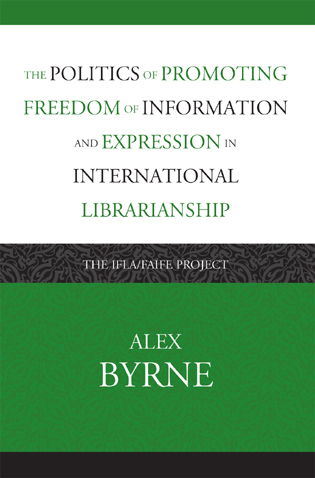
Alex Byrne, University Librarian at the University of Technology, Sydney, and 2005-2007 President of the International Federation of Library Associations and Institutions (IFLA), discusses intellectual freedom advocacy, libraries, internationalism, and his book: The Politics of Promoting Freedom of Information and Expression in International Librarianship, published by Scarecrow.

49:48 min.

Listen

John Willinsky

October 23, 2007

Public knowledge advocate John Willinsky discusses his book The Access Principle: The Case for Open Access to Research and Scholarship, winner of the American Library Association's 2006 Blackwell Scholarship Award, published by MIT Press.

47:53 min.

Listen

Perry Willett

April 17, 2007

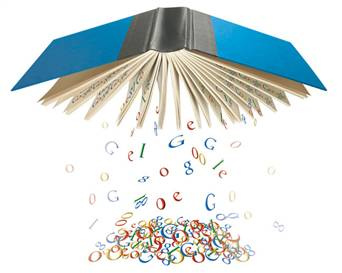
Perry Willett, Head of the Digital Library Production Service of the University of Michigan Libraries, discusses the U of M's role in the Google Books Library Project and Google's endeavor to translate the book holdings of the world's major research libraries into digital form for universal access via Google Book Search.
28:52 min.

Listen

Emily Sheketoff

April 3, 2007

Emily Sheketoff, Associate Executive Director of the American Library Association and head of the Washington Office of the ALA, talks about the important public policy issue of Network Neutrality and the threat that AT&T, Verizon, and other corporate media giants pose to equal access to information on the Internet.

27:17 min.

Listen

Patricia Phagan

February 6, 2007

Patricia Phagan, Curator of Prints and Drawings at the Frances Lehman Loeb Center at Vassar, talks about the exhibition: For the People: American Mural Drawings of the 1930s and 1940s, on view January 12 - March 11, 2007.

36:02 min

Listen | View | Screencast

Ray English

November 28, 2006

Ray English, Director of Libraries at Oberlin College and Chair of SPARC, the Scholarly Publishing and Academic Resources Coalition, will talk on behalf of the watershed Federal Research Public Access Act (S-2695) and its manifold benefits for libraries, higher education, and information-seekers at large, and about what you can do to help the cause of open access.

46:14 min

Listen

Rebecca Edwards

November 14, 2006

Rebecca Edwards, Eloise Ellery Professor of History at Vassar College, offers new perspectives on the transformations that swept the new American nation in the period between Emancipation and the first deployment of American troops overseas from her book New Spirits: Americans in the Gilded Age.
35:52 min


Listen