Showing posts with label Media Studies. Show all posts

Beauty out of the Ashes

Aaron Douglas. Cover Illustration for Fire!!  Devoted to Younger Negro Artists, ed. Wallace Thurman. New York, 1926..

March 1, 2023.

Professors Ronald D. Patkus, Eve Dunbar, and Caroline Culp discuss their current exhibition in the Thompson Memorial Library, Beauty out of the Ashes: Printed Works of the Harlem Renaissance, 1923-1936, on view through June 15, 2023.

A key focus of the exhibition is the literary production of the Harlem Renaissance. Works of thirteen different authors are presented. Together they provide a window into some of the key aspects of authorship during the Harlem Renaissance. At the same time, it’s also important to note that the exhibition considers not only texts, but also art, since the first editions of these works often included artwork on the dust jackets or within the book itself. By studying not just texts but also physical books, we gain a sense of the visual nature of published works, and thus a wider understanding for how works of the Harlem Renaissance were presented to their reading audience.


Listen

Hester Blum

March 30, 2022.

Hester Blum, Professor of English at Pennsylvania State University, discusses her book, The News at the Ends of the Earth: The Print Culture of Polar Exploration (Duke UP, 2019). 

"From Sir John Franklin's doomed 1845 search for the Northwest Passage to early twentieth-century sprints to the South Pole, polar expeditions produced an extravagant archive of documents that are as varied as they are engaging. As the polar ice sheets melt, fragments of this archive are newly emergent. In The News at the Ends of the Earth Hester Blum examines the rich, offbeat collection of printed ephemera created by polar explorers. Ranging from ship newspapers and messages left in bottles to menus and playbills, polar writing reveals the seamen wrestling with questions of time, space, community, and the environment. Whether chronicling weather patterns or satirically reporting on penguin mischief, this writing provided expedition members with a set of practices to help them survive the perpetual darkness and harshness of polar winters. The extreme climates these explorers experienced is continuous with climate change today. Polar exploration writing, Blum contends, offers strategies for confronting and reckoning with the extreme environment of the present."

Listen

Aaron Sinift, Kahkashan Khan, Jitendra Kumar


December 8, 2021.

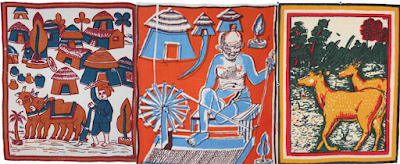
The Artist Aaron Sinift and project co-curators Kahkashan Khan and Jitendra Kumar discuss the artist book featured in the exhibition "OTHER IMAGININGS: Artist Collaborations with Gandhi Ashrams" on view in the Vassar College Art Library through March 4, 2022.

As western modes of advertising and television began to be adopted in India on a mass level in the early ’90s, there was a shift towards a generic global style in popular culture. The uniquely S. Asian styles of portrayal which flourished in the pre-digital era began to disappear as the imagination began to be more aggressively colonized. As vestiges of Gandhi ashram visual culture become rarer in public it is evident that we are nearing the end of a particular visual era that helped define a unique sense of Gandhian social purpose and national identity as popularly understood after Indian Independence.
 
The images in this book are traces of a world that exists even today and continues to provide a baseline means of self-sufficiency for tens of millions of people. Yet how we express ourselves is being transformed by our present circumstances and at this very moment is searching for its compelling voice. Perhaps this book is an opportunity to catch a glimpse before it’s gone of a more local sensibility that is unimpressed by glamour and worldliness, more focused on the ideals of communal harmony and love of country, particularly its rural pastoralist culture, what Gandhiji called “India’s heart and soul.”
 
As we reflect on these unique qualities (rasa), it is important as well to consider the present, the point from which we encounter the future, and from which we must find our voice. OTHER IMAGININGS is intended to create community (you included) and assert absolute equivalence among all participants so that no labor, no effort, no artist known or unknown is prized above any other. This artwork is an attempt to weave together stories rooted in community in order to create a primal resource for understanding and collaboration.

Listen

Buzz Spector

March 31, 2021.

The artist Buzz Spector talks about his retrospective exhibition at the St. Louis Art Museum on view through May 31, 2021: Buzz Spector: Alterations. Spector is a contemporary Conceptual artist who explores the aesthetic possibilities of language, paper, and books. The exhibition spans the artist’s career from the 1970s to the present and includes drawings, altered books, postcard assemblages, collages, and more. The artist also discusses the catalogue raisonée of his work just published by the Zolla/Lieberman Gallery in Chicago and available through the SLAM bookstore. Spector has recently moved his  home and studio to the Hudson Valley.

"Taking cues from Marcel Duchamp and Marcel Broodthaers—two influential 20th-century artists whose careers shaped the course of contemporary art—Spector draws from art historical precedents and adapts borrowed materials, injecting poetic humor and philosophical musings along the way. . . .

"Spector is internationally recognized for his contributions to the field of contemporary art. He taught painting, sculpture, and two-dimensional design at the Sam Fox School of Design & Visual Arts at Washington University in St. Louis for a decade before retiring in 2019. This is the first presentation of the artist’s work at a St. Louis museum."

The Rowland Atkinson skit we mention.

Art Speaks:  a 53 minute video on Buzz Spector: Alterations by SLAM


Listen

Leah Price

Edward Laning, The Story of the Recorded Word, WPA Mural Panel, McGraw Rotunda, NYPL 1938-42.

October 30, 2019.

Leah Price, Distinguished Professor of English  at Rutgers University and Founder and Director of the Rutgers Initiative for the Book, returns to the program to talk about her book, What We Talk About When We Talk About Books (New York: Basic Books, 2019).

"Price's book-unlike other examples of what she calls 'autobibliography'-is funny and hopeful, rather than dour and pious...What We Talk About When We Talk About Books is an enjoyable tour, full of surprising byways into historical arcana."―Jennifer Szalai, New York Times


Michael Joyce

September 18, 2019 (SEASON OPENER).

Michael Joyce, acclaimed novelist, poet, critic, media wayfinder,  and Professor of English at Vassar College, talks about his most recent novel, Remedia: A Picaresque (Steerage, 2018), and about creative writing, teaching, hypermedia and other conceptual wormholes, and about his relationship with media and literature. 

Count on Michael Joyce to reinvent the genre of the picaresque novel in a mode suited to the 21st century! With a light touch and sure sense of prose rhythm, he introduces a leitmotif of randomly appearing doorways, thresholds into and out of the world, to puncture the narrative space of this engaging novel. Scenes appear within scenes as the tales unfold in true keeping with the genre that recounts a hero’s progress. The sequence of events is made to make sense by sheer deftness of Joyce’s skill as a narrator and his willingness to use the unexpected as a structuring device, as well as an excuse to delight. Making sense of the past through the telling of his tales, Joyce offers his readers a fresh experience of a classic form filled with contemporary references. — Johanna Drucker

Arthur H. Groten


November 18, 2015.

Ephemerist/Philatelist Arthur H.Groton discusses the collection of poster stamps he assembled and recently gifted to Vassar College and the exhibit "Posters in Miniature: The Ephemeral Cinderella" on view in the Vassar College Art Library through December 16.

40:40 minutes.

Listen

Mary-Kay Lombino

October 21, 2015.

Mary Kay Lombino, Emily Hargroves Fisher 1957 and Richard B. Fisher Curator of Collections at the Frances Lehman Loeb Art Center at Vassar College, discusses the exhibition on view at the Frances Lehman Loeb Art Center September 25 - December 13, 2015 entitled “Gordon Parks: The Making of an Argument."

“Gordon Parks was one of America’s most significant social photographers, filmmakers, and writers of the twentieth century, and the first African-American photographer to work for Life magazine. In 1948, he began a professional relationship with Life that would last twenty-two years when he proposed a series of pictures about the gang wars that were then plaguing Harlem. Parks gained the trust of one group of gang members and their leader Red Jackson, producing photographs of them that are artful, emotive, poignant, and sometimes shocking. From this larger body of work, twenty-one pictures were selected for a photo essay in Life. The exhibition comprises forty-five prints alongside contact sheets, issues of the original publication, and related ephemera that both contextualize the images chosen for the story and suggest the ways in which the editorial process shapes the narrative arc."

37:40 minutes.

Listen 


Alix Christie

February 18, 2015.  

Writer, journalist, and printer Alix Christie, (VC'80) talks about her historical novel, Gutenberg's Apprentice (Harper Collins, 2014).


"If ever there were a historical novel with up-to-the-minute resonance, this is it. As we go through another information revolution, Christie’s novel takes us back in brilliantly-observed detail to the first – the invention of the printing press. Her characters are engaging, the world as beautifully crafted as one of Gutenberg’s hot-metal letters, and the themes more relevant now than ever."


51:42 minutes

Listen

Jeffrey T. Schnapp


February 4, 2015.

Harvard cultural historian and media theorist Jeffrey T. Schnapp (VC'75), Co-director of the Berkman Center for the Internet and Society and founding Faculty Director of the Harvard Graduate School of Design's knowledge design studio metaLAB, talks about his new book, co-authored with Matthew Battles, entitled The Library Beyond the Book (Harvard, 2014), as well as about the Library Test Kitchen and experiments in library interfaces for the digital age.  


"With textbook readers and digital downloads proliferating, it is easy to imagine a time when printed books will vanish. Such forecasts miss the mark, argue Jeffrey Schnapp and Matthew Battles. Future bookshelves will not be wholly virtual, and libraries will thrive, although in a variety of new social, cultural, and architectural forms. Schnapp and Battles combine deep study of the library's history with a record of institutional and technical innovation at metaLAB, a research group at the forefront of the digital humanities. They gather these currents in The Library Beyond the Book, exploring what libraries have been in the past to speculate on what they will become: hybrid places that intermingle books and ebooks, analog and digital formats, paper and pixels."

56.34 minutes.

Listen 

Johanna Drucker

October 29, 2014.

Scholar, artist, printer, and visual theorist Johanna Drucker, Breslauer Professor of Bibliographical Studies at the Graduate School of Education and Information Studies at the University of California, Los Angeles, discusses her book Graphesis: Visual Forms of Knowledge Production (Harvard 2014).

"Information graphics bear tell-tale signs of the disciplines in which they originated: statistics, business, and the empirical sciences. Drucker makes the case for studying visuality from a humanistic perspective, exploring how graphic languages can serve fields where qualitative judgments take priority over quantitative statements of fact. Graphesis offers a new epistemology of the ways we process information, embracing the full potential of visual forms and formats of knowledge production."


48:20  minutes

Listen 

Lisa Gitelman


September 17, 2014. (SEASON OPENER):

Lisa Gitelman, Professor of English and of Media, Culture, and Communication at New York University, will discuss her book Paper Knowledge: Toward a Media History of Documents (Duke University Press, 2014).

"Paper Knowledge is a remarkable book about the mundane: the library card, the promissory note, the movie ticket, the PDF (Portable Document Format). It is a media history of the document. Drawing examples from the 1870s, the 1930s, the 1960s, and today, Lisa Gitelman thinks across the media that the document form has come to inhabit over the last 150 years, including letterpress printing, typing and carbon paper, mimeograph, microfilm, offset printing, photocopying, and scanning. Whether examining late nineteenth century commercial, or "job" printing, or the Xerox machine and the role of reproduction in our understanding of the document, Gitelman reveals a keen eye for vernacular uses of technology. She tells nuanced, anecdote-filled stories of the waning of old technologies and the emergence of new. Along the way, she discusses documentary matters such as the relation between twentieth-century technological innovation and the management of paper, and the interdependence of computer programming and documentation. Paper Knowledge is destined to set a new agenda for media studies."

42:10 minutes.

Listen 

Elizabeth Eisenstein

May 28, 2014. (SEASON FINALE):

Elizabeth Eisenstein (VC'45), author of the massively influential history on the impact of the introduction of printing on Western society, The Printing Press as an Agent of Change (2 vols., Cambridge 1979), will discuss her book Divine Art, Infernal Machine: The Reception of Printing in the West (U Penn, 2011).

"Eisenstein's research is impressive, reaching far and wide across languages and centuries. Her knowledge of the history of publication engages the wealth of recent scholarship and extends as far back as Roman copyists. . . . Her breadth enables her to identify topoi and their mutations; to observe long-term trends, diminishing ripples, and delayed reactions; and to distinguish what is new or newly dressed in authors' concerns and readers' complaints."— Journal of Scholarly Publishing

45:57 minutes.

Listen

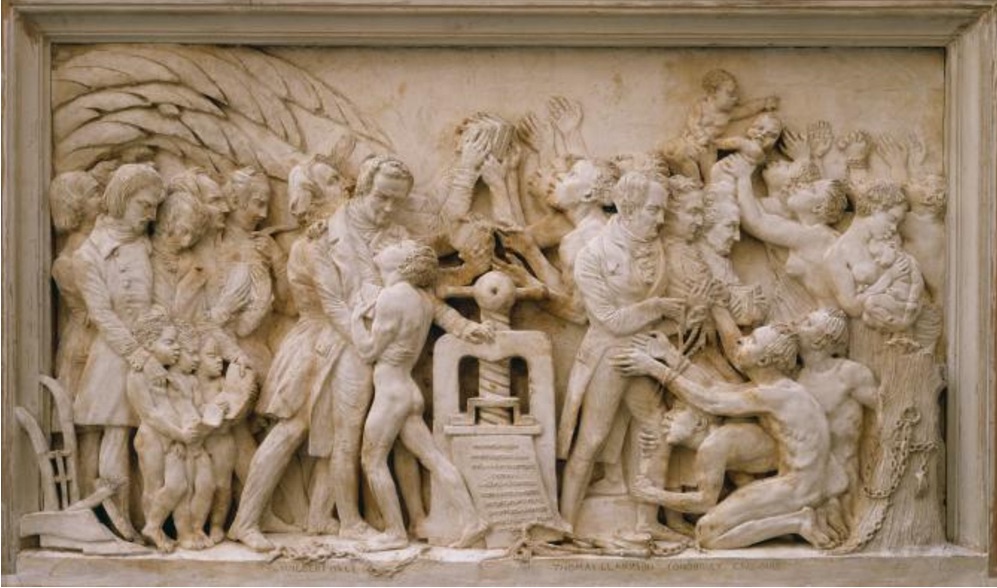
Robert Darnton

April 30, 2014.

Robert Darnton, Carl H. Pforzheimer University Professor and University Librarian at Harvard University talks about his book Poetry and the Police: Communication Networks in Eighteenth-Century Paris (Harvard, 2012).

"In 1749 Parisians feasted on a half-dozen poems that ridiculed Louis XV for being humiliated in foreign affairs by the Treaty of Aix-la-Chapelle as well as in the royal bed by an ignoble mistress. The king ordered a crackdown on unauthorized poetry recitals, and the police rounded up fourteen suspects, mostly students, clerks and priests, and gathered evidence. The investigation is the subject of Robert Darnton's fascinating Poetry and the Police: Communication Networks in Eighteenth-Century Paris. As Darnton retraces the steps of the police, he branches off into explorations of the world of ordinary people under the ancien régime and the formation of public opinion in an oral culture. He also has a polemical aim. 'The marvels of communication technology in the present have produced a false consciousness about the past,' he writes, 'even a sense that communication has no history' before the days of television and the Internet. Darnton deflates that illusion by showing how poems seeped into the public sphere as they passed through oral and print media: first copied on scraps of paper, then dictated by one person to another, then memorized and sung to an audience. For Darnton, poetry was an information network long before networks were news." -- John Palattella The Nation

58:43 minutes.

Listen

Wolfgang Ernst

February 19, 2014.

Wolfgang Ernst, Chair of Media Theories at Humboldt University, Berlin, talks about media archaeology and his book Digital Memory and the Archive, published last year by the University of Minnesota Press.

"Digital Memory and the Archive offers the most compelling and insightful account published to date of how and why objects matter. Moving beyond textual analysis, its careful, theoretically rigorous engagement with the relic—the physicality of the archive—promises to change the direction of the digital humanities. Thanks to this book, we will all now be addressing the microtemporality of archives and the mechanics of remaining. Finally, a definitive collection in English of one of the most brilliant and influential media archaeologists."   -- Wendy Hui Kyong Chun

32:24 minutes.

Listen

Leah Price

May 8, 2013:  SEASON FINALE.

Leah Price, Professor of English at Harvard University and Senior Advisor in the Humanities at the Radcliffe Institute for Advanced Study, discusses her book: How To Do Things With Books in Victorian Britain, published by Princeton University Press in 2012.

“Leah Price has challenged every book historian, librarian, and reader of secular or spiritual scripture to think through the object we fondle or maul and the ways in which it circulates in whole and in pieces through our home and global economies. . . . [T]here's no doubt in my mind that this is a potent intervention in the study of material culture. No one who cares about books should miss handling and reading it." -- Robert L. Patten, Review of English Studies

1:05:23 minutes.

Listen

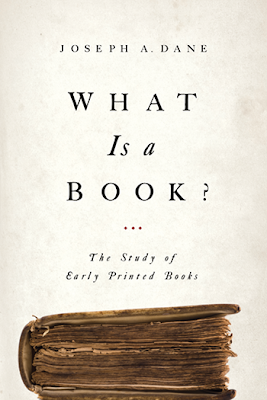
Joseph A. Dane

April 10, 2013.

Joseph A. Dane discusses his book, What Is a Book?: The Study of Early Printed Books, Published by the University of Notre Dame Press in 2012.

“Joseph A. Dane is one of our most brilliant and prolific scholars of the early book, and this volume culminates a lifetime of research. For the general reader, it will offer a compelling survey of book history and book making. For the specialist, it will offer insights into the techniques of printers and the lives of collectors. For anyone concerned with how we read the past, and for anyone fascinated by the book as typographical artifact, What Is a Book? will be deeply valued." -- Seth Lehrer, UCSD.


49:56 minutes. 

Listen

Andrew Piper

February 13, 2013.

Andrew Piper, Associate Professor in the Department of Languages, Literatures, and Cultures and associate member of the Department of Art History and Communication Studies at McGill University, discusses his book Book Was There: Reading in Electronic Times, published in 2011 by the University of Chicago Press.

“Contending that our lived experience of reading belies naive generalizations about the future of books, Book Was There is an elegantly argued and thoroughly up-to-date tribute to the endurance of books in our evolving digital world."

Professor Piper's first book, which won the Modern Language Association Prize for a first book is entitled Dreaming in Books: The Making of the Bibliographic Imagination in the Romantic Age (Chicago UP, 2009).  He is co-founder of the research group, Interacting with Print: Cultural Practices of Intermediality, 1700-1900.

55:07 mins.

Listen

N. Katherine Hayles

January 30, 2013.

N. Katherine Hayles, Director of Graduate Studies in the Program in Literature at Duke University and widely regarded as the most illuminating public intellectual writing on technology and culture today, talks about her latest book: How We Think: Digital Media and Contemporary Technogenesis, Published by the University of Chicago Press.

“With a rift growing between digital scholarship and its print-based counterpart, Hayles argues for contemporary technogenesis—the belief that humans and technics are coevolving—and advocates for what she calls comparative media studies, a new approach to locating digital work within print traditions and vice versa."

40:48 mins.

Listen

Adam Michaels

October 24, 2012.

Adam Michaels, principle designer at Project Projects, talks about the book he co-authored with Jeffrey T. Schnapp entitled: The Electronic Information Age Book: McLuhan/Agel/Fiore and the Experimental Paperback, an Inventory Book published this year by Princeton Architectural Press.

“The Electric Information Age Book explores the nine-year window of mass-market publishing in the sixties and seventies when formerly backstage players—designers, graphic artists, editors—stepped into the spotlight to produce a series of exceptional books. "

61:23 min.

Listen