October 31, 2018.
Yvonne Elet, Associate Professor of Art at Vassar College, talks about Raphael as an architect and her book Architectural Invention in Renaissance Rome: Artists, Humanists, and the Planning of Raphael's Villa Madama.
"Villa Madama, Raphael's late masterwork of architecture, landscape, and decoration for the Medici popes, is a paradigm of the Renaissance villa. The creation of this important, unfinished complex provides a remarkable case study for the nature of architectural invention. Drawing on little known poetry describing the villa while it was on the drawing board, as well as ground plans, letters, and antiquities once installed there, Yvonne Elet reveals the design process to have been a dynamic, collaborative effort involving humanists as well as architects. She explores design as a self-reflexive process, and the dialectic of text and architectural form, illuminating the relation of word and image in Renaissance architectural practice. Her revisionist account of architectural design as a process engaging different systems of knowledge, visual and verbal, has important implications for the relation of architecture and language, meaning in architecture, and the translation of idea into form."
Listen
Showing posts with label Renaissance Studies. Show all posts
Arielle Saiber
Season Opener: September 26, 2018.
Arielle Saber, Professor of Romance Languages & Literatures at Bowdoin College, discusses her book Measured Words: Computation and Writing in Renaissance Italy, winner of the 19th annual MLA Aldo and Jeanne Scaglione Publication and the Newberry Library's 2017 Weiss-Brown Publication Award (U Toronto, 2017).
Arielle Saiber explores the relationship between number, shape, and the written word in the works of four exceptional thinkers: Leon Battista Alberti’s treatis on cryptography, Luca Pacioli’s ideal proportions for designing Roman capital letters, Niccolò Tartaglia’s poem embedding his solution to solving cubic equations, and Giambattista Della Porta’s curious study on the elements of geometric curves. Although they came from different social classes and practiced the mathematical and literary arts at differing levels of sophistication, they were all guided by a sense that there exist deep ontological and epistemological bonds between computational and verbal thinking and production. Their shared view that a network or continuity exists between the arts yielded extraordinary results. Through measuring their words, literally and figuratively, they are models of what the very best interdisciplinary work can offer us.
Listen
Meredith J. Gill
March 28, 2018.
Meredith J. Gill, Professor of 15th and 16th Century Italian Art at the University of Maryland, talks about her latest book Angels and the Order of Heaven in Medieval and Renaissance Italy (Cambridge, 2014).
(Cambridge 2014).
"In this beautifully written and deeply thoughtful book, Meredith Gill, one of the
best scholars working in the field of medieval and Renaissance art history,
tackles a highly compelling subject that has been “hidden in plain sight.” It
considers the difference between medieval and Renaissance angelology,
offering close readings of angels in the literary tradition and the visual arts
(such as Guariento, Melozzo da Forlì, Raphael, and Rosso). It explores
angels’ relationship to the immaterial, as graceful bodies imbued with aria,
and their meaning in the history of devotion and philosophy. Gill’s writing
style is in harmony with her topic, and her deeply engaging prose never fails
to transport the reader into its beauty and mystery. Drawing upon earlier
excellent work on St Augustine, Gill’s extensive but lightly worn knowledge of Christian thought—a rare achievement amongst art historians today—lays
the foundation for every chapter. The book is an essential read not only for
art historians, but for anyone with an interest in medieval and Renaissance
Christianity." --Kathleen Christian, The Open University
Labels:
Allegory,
Angels,
Art History,
Medieval Studies,
Philosophy,
Religion,
Renaissance Studies,
Theology,
VC
Brent Sverdloff
April 12, 2017.
Brent Sverdloff, memory coach and author of How Could I Forget You: A Creative Way to Remember Names and Faces, talks about the ancient art of training your memory to help you better remember people, names, and information for academic examinations.
"When you are ready to admit that you need help remembering names and faces, this book is the place to start. Using playful methods based on how our minds generate information, Sverdloff shows us how we can get our brains back in gear." —Timothy Young, The Yale Review
49:57 minutes.
Gloria Kury
November 9, 2016.
Art historian, editor, and publisher Gloria Kury (VC '65) talks about art history, literature, education, and the fabrication of the Renaissance in the 19th century and her book When Giorgione Died: A Rebuildungsroman in Two Volumes (Periscope, 2016).
"A memory book with a fierce verve for piercing the false enchantments of memory, its dangerous nostalgias, its zombies and composite monsters, its necrophilia and kitsch. Exuberantly in love with art, Gloria Kury works to disentangle the blind-paths of connoisseurship and historical scholarship, what so often gets forgotten there - and what hides in plain sight. A brilliant story teller herself, she trusts other storytellers - Shakespeare, Henry James, Edith Wharton, William Gaddis, Cindy Sherman among others - to lay bear the strangeness of things, even as she invites the wild-eyed prophets, the crystal gazers, the code breakers, the hypnotists, the psychics, the psychologists, the parapsychologists, the time travelers, the explorers of the fourth dimension to say their part. Seeded within this complex slide show is a sharp, cohesive, often comic and sometimes chilling meditation on how any life is lived and remembered, how smoke gets in your eyes." -- Kenneth Gross, author of The Dream of the Moving Statue and Puppet: An Essay on Uncanny Life
59:30 minutes.
Listen
Patricia Phagan
November 5, 2014.
Patricia Phagan, Philip and Lynn Straus Curator of Prints and Drawings at the Frances Lehman Loeb Art Center at Vassar, will discuss the exhibition currently on view at the Center through December 14, 2014 entitled: Imperial Augsburg: Renaissance Prints and Drawings, 1475-1540.
"Like Albrecht Dürer’s Nuremberg, the city of Augsburg was vital to the flowering of the Renaissance in Germany. The exhibition features prints, drawings, illustrated books, medals, and armor from Augsburg and addresses the themes of Christian devotion and the Reformation, moral conduct and everyday life, and art made for Holy Roman Emperor Maximilian I."
34:41 minutes.
Christopher D. Johnson
April 9, 2014.
Christopher D. Johnson, Professor of early modern literature in the Department of Spanish and Portuguese at UCLA, discusses his book, Memory, Metaphor, and Aby Warburg's Atlas of Images, published by Cornell University Press in 2012.
"This is a rich and learned book, and also an extremely humane and attractive one. The final chapter, on Warburg and Bruno, has the status of revelation. It is absolutely fascinating, not only as a dialogue in intellectual history but also as a political allegory. Christopher D. Johnson pays close attention to Warburg's ethical and epistemological aspirations when he focuses on Warburg’s final and uncompleted project: the Atlas of Images. Assembled during the years prior to his death in 1929, these collages strove to mount a history of cultural memory via a dense series of images from antiquity to the present." — Michael P. Steinberg, Brown University
45:24 minutes.
Listen
View select panels from Warburg's Bilderatlas and other materials on the book's companion website.
Christopher D. Johnson, Professor of early modern literature in the Department of Spanish and Portuguese at UCLA, discusses his book, Memory, Metaphor, and Aby Warburg's Atlas of Images, published by Cornell University Press in 2012.
"This is a rich and learned book, and also an extremely humane and attractive one. The final chapter, on Warburg and Bruno, has the status of revelation. It is absolutely fascinating, not only as a dialogue in intellectual history but also as a political allegory. Christopher D. Johnson pays close attention to Warburg's ethical and epistemological aspirations when he focuses on Warburg’s final and uncompleted project: the Atlas of Images. Assembled during the years prior to his death in 1929, these collages strove to mount a history of cultural memory via a dense series of images from antiquity to the present." — Michael P. Steinberg, Brown University
45:24 minutes.
Listen
View select panels from Warburg's Bilderatlas and other materials on the book's companion website.
Nicholas Adams
February 5, 2014.
Architectural historian and Mary Conover Mellon Professor of Art Nicholas Adams talks about the exhibition now on view in the Vassar College Library, Art Library, and Frances Lehman Loeb Center entitled: The Architect's Library: Notable Books on Architectural Themes in the Vassar College Library.
"The book as the site of canonicity and debate from Vignola to Robert Venturi was the overarching theme of the exhibition, one of whose contributions was to remind us that the design of the book itself participated powerfully in projecting the artistic attitudes that shaped its content. . . . This exhibition showed that the study of what libraries own in the field of architecture, how titles were acquired or received through donation, and the significance of a collection for an institution’s identity and development are worthy educational topics." -- Joseph M. Siry, JSAH
41:43 minutes.
Listen
Architectural historian and Mary Conover Mellon Professor of Art Nicholas Adams talks about the exhibition now on view in the Vassar College Library, Art Library, and Frances Lehman Loeb Center entitled: The Architect's Library: Notable Books on Architectural Themes in the Vassar College Library.
"The book as the site of canonicity and debate from Vignola to Robert Venturi was the overarching theme of the exhibition, one of whose contributions was to remind us that the design of the book itself participated powerfully in projecting the artistic attitudes that shaped its content. . . . This exhibition showed that the study of what libraries own in the field of architecture, how titles were acquired or received through donation, and the significance of a collection for an institution’s identity and development are worthy educational topics." -- Joseph M. Siry, JSAH
41:43 minutes.
Listen
Joseph A. Dane
April 10, 2013.
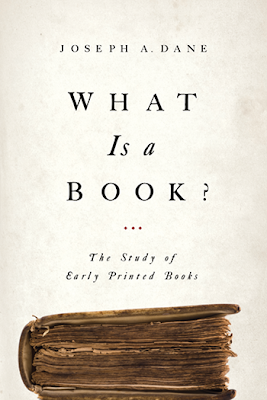
Joseph A. Dane discusses his book, What Is a Book?: The Study of Early Printed Books, Published by the University of Notre Dame Press in 2012.
“Joseph A. Dane is one of our most brilliant and prolific scholars of the early book, and this volume culminates a lifetime of research. For the general reader, it will offer a compelling survey of book history and book making. For the specialist, it will offer insights into the techniques of printers and the lives of collectors. For anyone concerned with how we read the past, and for anyone fascinated by the book as typographical artifact, What Is a Book? will be deeply valued." -- Seth Lehrer, UCSD.
49:56 minutes.
Listen
Joseph A. Dane discusses his book, What Is a Book?: The Study of Early Printed Books, Published by the University of Notre Dame Press in 2012.
“Joseph A. Dane is one of our most brilliant and prolific scholars of the early book, and this volume culminates a lifetime of research. For the general reader, it will offer a compelling survey of book history and book making. For the specialist, it will offer insights into the techniques of printers and the lives of collectors. For anyone concerned with how we read the past, and for anyone fascinated by the book as typographical artifact, What Is a Book? will be deeply valued." -- Seth Lehrer, UCSD.
49:56 minutes.
Listen
Lisa Kaborycha
November 14, 2012.
Lisa Kaborycha, Director of Academic Affairs at the Medici Archive Project and Professor of History at the University of California EAP in Florence, talks about the project and its extraordinary educational and research programs. This December the Medici Archive Project will launch its BIA digital interactive platform on the Web, which will eventually provide digital access to between three and four million letters and other documents in the archives of the Medici Granducal Collection, and promises to revolutionize research in early modern studies across the disciplines.
42:02 min.
Listen
Lisa Kaborycha, Director of Academic Affairs at the Medici Archive Project and Professor of History at the University of California EAP in Florence, talks about the project and its extraordinary educational and research programs. This December the Medici Archive Project will launch its BIA digital interactive platform on the Web, which will eventually provide digital access to between three and four million letters and other documents in the archives of the Medici Granducal Collection, and promises to revolutionize research in early modern studies across the disciplines.
42:02 min.
Listen
Nancy Bisaha
March 4, 2008.
Nancy Bisaha, professor of history at Vassar College, talks about her book, Creating East and West: Renaissance Humanists and the Ottoman Turks, which "underscores the importance of this period for the evolution of concepts such as East and West, Europe and Asia, and suggests how these Renaissance views ... may still inform the modern discourse on Islam and the West." - RQ
50:10 min.
Listen
Nancy Bisaha, professor of history at Vassar College, talks about her book, Creating East and West: Renaissance Humanists and the Ottoman Turks, which "underscores the importance of this period for the evolution of concepts such as East and West, Europe and Asia, and suggests how these Renaissance views ... may still inform the modern discourse on Islam and the West." - RQ
50:10 min.
Listen
Subscribe to:
Posts (Atom)